What is Amazon Elastic Beanstalk?
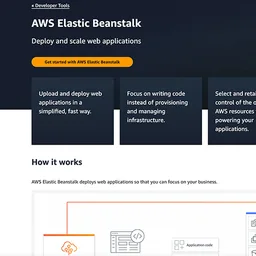
Amazon Elastic Beanstalk automates the deployment process of your web applications, handling everything from capacity provisioning and load balancing to auto-scaling and application health monitoring. By abstracting the complexities of underlying infrastructure, it allows developers to focus on writing code rather than managing servers. The service supports Java, .NET, PHP, Node.js, Python, Ruby, Go, and Docker. It integrates seamlessly with AWS resources, providing a robust, scalable environment for startups seeking rapid development and enterprise teams looking to streamline their deployment pipelines. Whether launching a simple web app or a complex microservice architecture, Beanstalk provides the control and flexibility needed for seamless production operations.
Key Features
- Automated infrastructure provisioning
- Multi-language platform support
- Dynamic capacity scaling
- Seamless AWS service integration
Pros
- Reduces manual deployment effort.
- Simplifies server management tasks.
- Scales resources automatically.
Cons
- Configuration can be complex.
- Limited granular server control.
- Cost management requires oversight.
Who is Using Amazon Elastic Beanstalk?
Software developers use it to quickly deploy web applications without spending time on manual server configuration and infrastructure setup.
Startup founders utilize the platform to scale their services rapidly as their user base grows without needing to hire dedicated DevOps engineers.
IT systems administrators leverage the service to centralize application health monitoring and ensure high availability across various AWS environments.
Pricing
| Plan | Price | Key Features |
|---|---|---|
| Elastic Beanstalk | No additional charge | No extra Beanstalk service fee,Pay only for underlying AWS resources,Managed deployment and scaling |
Elastic Beanstalk
No additional charge
- No extra Beanstalk service fee,Pay only for underlying AWS resources,Managed deployment and scaling