What is Temporal Gaussian Hierarchy?
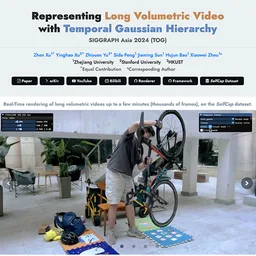
Temporal Gaussian Hierarchy addresses the challenge of capturing complex, high-resolution dynamic scenes with limited camera viewpoints. By leveraging a hierarchical representation of Gaussian splatting, the tool intelligently tracks motion across time to produce photorealistic 4D reconstructions. It effectively solves the problem of temporal inconsistency and blurry movement often found in traditional volumetric capture methods. This solution is ideal for researchers, computer graphics engineers, and digital content creators looking to generate immersive 3D-dynamic assets for virtual reality, gaming, and cinematic visual effects. By utilizing innovative neural rendering techniques, it provides a balance between high-fidelity visual output and efficient computational performance, allowing users to synthesize novel views with high accuracy.
Key Features
- 4D volumetric scene reconstruction
- Hierarchical temporal motion tracking
- High fidelity neural rendering
- Multi-view consistent generation
Pros
- Reduces reconstruction time significantly.
- Ensures high visual fidelity.
- Streamlines complex animation workflows.
Cons
- Requires high computational hardware.
- Limited to specific inputs.
- High initial learning curve.
Who is Using Temporal Gaussian Hierarchy?
Computer graphics researchers utilize the tool to push the boundaries of 4D scene understanding and realistic neural rendering, seeking to replace traditional labor-intensive capture methods.
Game developers deploy this system to transform real-world actor performances into high-quality 3D assets, enhancing the visual realism of characters in modern gaming environments.
Virtual reality content creators adopt this technology to craft immersive, photorealistic experiences that maintain visual integrity during complex movements throughout 3D space.